Emoji meanings: what 47 popular emoji really mean
On this page
In short
Emoji meanings depend on context. Each emoji has an official Unicode name, such as face with tears of joy for 😂, but the Unicode Consortium says the name doesn't define the meaning, which varies with language, culture and time. This guide pairs each popular emoji's official name with the way people commonly use it.
Key takeaways
- Every emoji has an official Unicode name, but the Unicode Consortium says that name doesn't define what the emoji means.
- Meanings depend on language, culture and context, and they change over time. 💀 usually means "that's so funny", not death.
- The same emoji looks different on an iPhone, an Android phone and a laptop, because each company draws its own version.
- When an emoji could be read two ways, add a few words. Tone is easy to misread in text.
Emoji meanings are slippery. The crying face is often used for laughing, the skull is a compliment, and the same smile can look warm on one phone and awkward on another. That's not a bug. According to the Unicode Consortium's emoji FAQ, emoji are added to the standard mainly for how they look, not for a fixed meaning, and the meaning can vary with language, culture and context.
So this guide gives you two things for each emoji people ask about most: its official Unicode name, checked against the Unicode emoji list, and the way people commonly use it in messages and on social media. Treat the second column as a guide to how it's usually read, not a rule.
Why emoji meanings change
Three facts from Unicode's own FAQ explain most of the confusion.
- The name is an ID, not a definition. Unicode says a character name is a unique identifier that may not cover every meaning of an emoji, and in some cases can even be misleading.
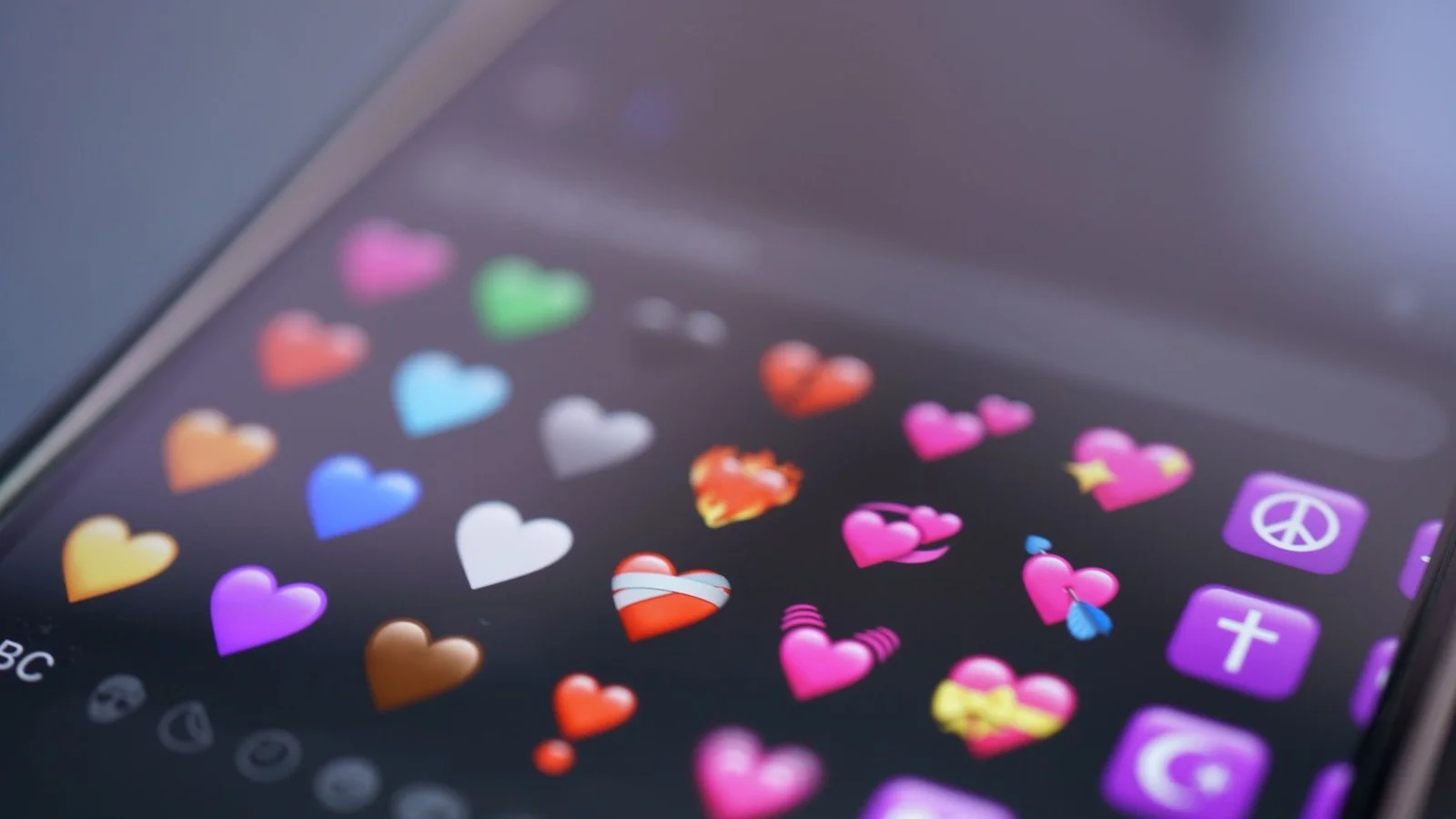
- Unicode doesn't draw the emoji. Apple, Google, Samsung, Microsoft and the apps you use design their own images. Unicode has no control over how emoji appear on their platforms, which is why 😬 can look playful on one phone and pained on another.
- Usage moves on. Unicode notes that meanings can change or be repurposed over time. 🔥 started as a flame and now mostly means "this is great".
Skin tones work the same way across platforms: many people and hand emoji can be followed by one of five skin tone modifiers based on the Fitzpatrick scale, and Unicode recommends a neutral look when no modifier is chosen.
Laughing and happy faces
| Emoji | Unicode name | How people usually use it |
|---|---|---|
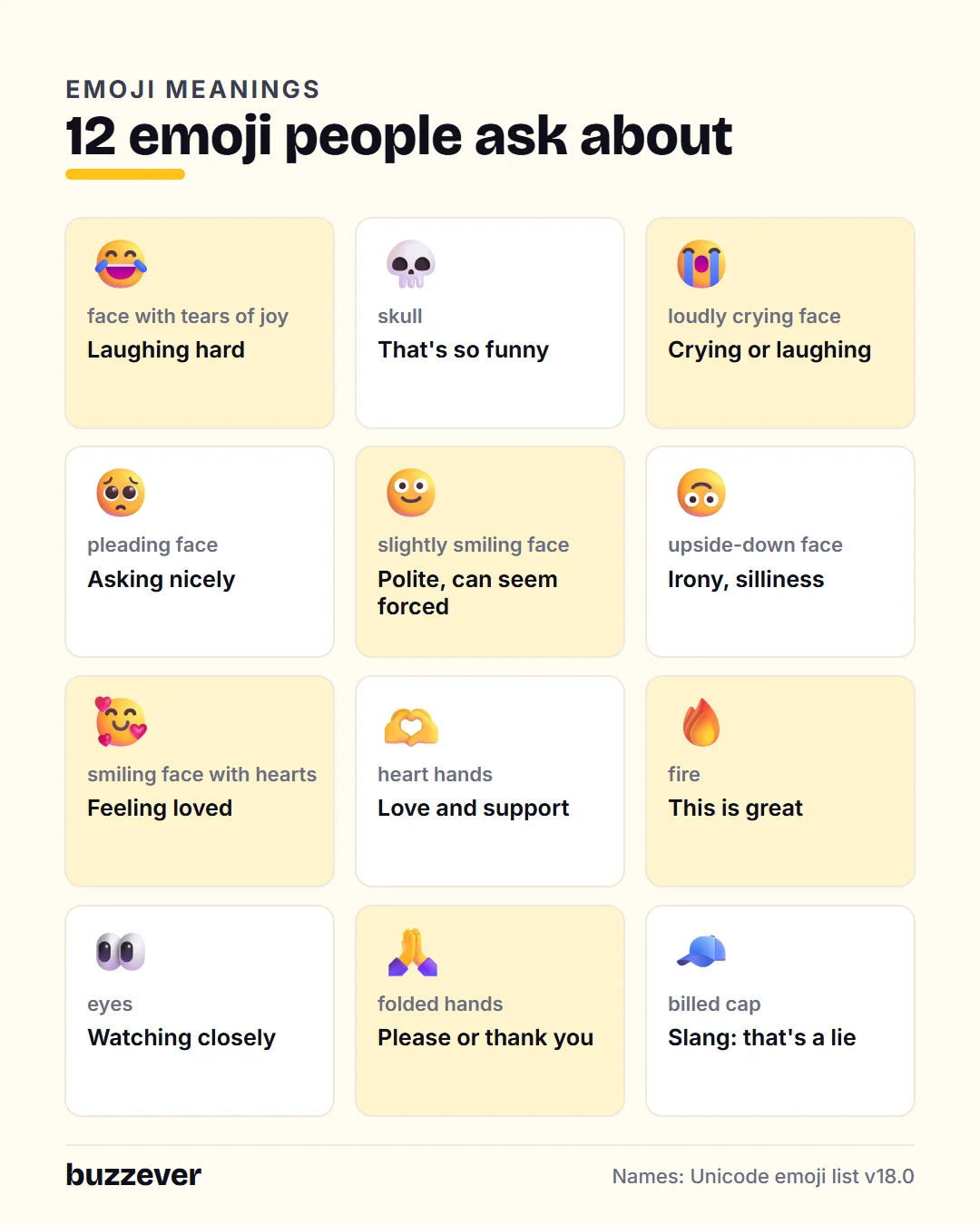
| 😂 | face with tears of joy | Laughing hard. Still very common, though many people now use 💀 or 😭 for the same thing |
| 🤣 | rolling on the floor laughing | Even louder laughter than 😂 |
| 😊 | smiling face with smiling eyes | Warm, genuine happiness or thanks |
| ☺️ | smiling face | A softer, shy or content smile |
| 🙂 | slightly smiling face | Polite. Between friends it can read as forced or passive-aggressive |
| 🙃 | upside-down face | Irony, silliness, or "everything's fine" when it isn't |
| 😅 | grinning face with sweat | Nervous laugh, relief, a small embarrassing moment |
| 🥲 | smiling face with tear | Happy and sad at once, proud, touched, or "I'm laughing so I don't cry" |
| 😇 | smiling face with halo | Innocent, angelic, or pretending to be |
Love and affection
| Emoji | Unicode name | How people usually use it |
|---|---|---|
| ❤️ | red heart | Love, the classic. Also a quick "I like this" |
| 😍 | smiling face with heart-eyes | Adoring something or someone: a photo, food, a new outfit |
| 🥰 | smiling face with hearts | Feeling loved or affectionate, softer than 😍 |
| 😘 | face blowing a kiss | Affection, flirting, or a friendly sign-off |
| 🫶 | heart hands | Love and support, often aimed at a friend or a creator |
| 💕 | two hearts | Light, cute affection |
| 🤍 | white heart | Calm or pure love, popular in clean, minimal bios |
| 🖤 | black heart | Dark humour, a goth or edgy style, or simply a love of black |
| 💔 | broken heart | Heartbreak, disappointment, or mock sadness |
If you post hearts often, our heart symbol page has the text versions you can copy into bios and captions.
Sad, awkward and nervous
| Emoji | Unicode name | How people usually use it |
|---|---|---|
| 😭 | loudly crying face | Real sadness, but just as often overwhelming laughter or "this is too cute" |
| 🥺 | pleading face | Puppy eyes: asking nicely, or being touched by something |
| 🥹 | face holding back tears | Moved, grateful, proud |
| 😬 | grimacing face | Awkward, yikes, a bit of bad news |
| 😳 | flushed face | Embarrassed, shocked, or flattered |
| 🫠 | melting face | Overwhelmed, embarrassed, or melting from heat |
| 🫣 | face with peeking eye | Can't look, but kind of want to; shy curiosity |
Attitude, side-eye and sarcasm
| Emoji | Unicode name | How people usually use it |
|---|---|---|
| 😏 | smirking face | Smug, flirty, or "I know something you don't" |
| 🙄 | face with rolling eyes | Annoyed, unimpressed, "whatever" |
| 🤔 | thinking face | Considering something, or doubting it |
| 👀 | eyes | Watching closely, curiosity, "I see what's happening here" |
| 🤡 | clown face | Calling someone (often yourself) foolish |
| 💅 | nail polish | Unbothered confidence, sass |
Hands and gestures
| Emoji | Unicode name | How people usually use it |
|---|---|---|
| 🙏 | folded hands | Please, thank you, or praying. Some people read it as a high five, which the Unicode keywords also list |
| 👍 | thumbs up | Yes, OK, good. Can feel curt to some readers when used alone |
| 👏 | clapping hands | Applause, or emphasis between words |
| 🙌 | raising hands | Celebration, "finally", praise |
| 💪 | flexed biceps | Strength, the gym, "you've got this" |
| 🤝 | handshake | A deal, agreement, partnership |
| 🤌 | pinched fingers | "What do you mean?", or "perfect", depending on the context |
| 🫡 | saluting face | Respect, "yes sir", or accepting a task |
Emoji that mean something else online
These are the ones that confuse people most, because their everyday use has drifted far from the picture.
| Emoji | Unicode name | How people usually use it |
|---|---|---|
| 💀 | skull | "I'm dead", meaning something is so funny. The Unicode keywords for it even include "dead" and "lmao" |
| 🔥 | fire | Great, hot, exciting |
| ✨ | sparkles | Magic, something new, or emphasis around words. Sometimes sarcastic |
| 💯 | hundred points | Totally agree, keeping it real |
| 🐐 | goat | The greatest of all time, from the acronym GOAT |
| 🧢 | billed cap | In slang, "cap" means a lie, so 🧢 calls something out as untrue |
| 👉 | backhand index pointing right | Pointing at a link or the next thing; doubled 👉👈 means shy |
| 🎉 | party popper | Congratulations, celebrations, announcements |
☺️ vs 😊: what's the difference?
They're two separate emoji. ☺️ is officially "smiling face" and 😊 is "smiling face with smiling eyes". In everyday use 😊 reads as warmer and more open, while ☺️ often reads as shy or content. Because each phone maker draws its own version, the difference can look big on one device and tiny on another. If tone matters, add a word or two.
How to use emoji in captions and bios
- Use them as signposts. One emoji at the start of a line works like a bullet point and makes a caption easier to scan.
- Don't replace key words. Search and screen readers handle words better than pictures, so write the important word and add the emoji after it.
- Check the other side. If you're writing for an audience in another country, look up how an emoji is read there before you rely on it.
- Keep it to a few. Three well-placed emoji say more than a row of twelve.
Need symbols that aren't emoji, like stars, arrows or dividers? Our copy-and-paste symbols page has them ready in one tap, and the caption generator can draft the words around them.
Read next: Instagram captions: ideas by purpose, plus the rules and Instagram bio ideas: a simple formula and 18 patterns to adapt.
Read the room
Emoji add tone that plain text lacks, and they're also easy to misread. Use the table as a starting point, watch how your own friends and followers use them, and when in doubt, say it in words too. More guides for creators are on Buzzever's Instagram page.
Questions readers ask
Is there an official list of emoji meanings?
Not of meanings. The Unicode Consortium publishes an official emoji list with each emoji's name and keywords, but it says the name doesn't define the meaning, and that meanings vary with language, culture and context.
What does 🥰 mean?
Its Unicode name is "smiling face with hearts". People use it to show they feel loved or affectionate, for example under a sweet message or a photo of a partner, a pet or a friend. It's softer than 😍.
What does the skull emoji 💀 mean?
Online it usually means "I'm dead", as in "that's so funny". Unicode's own keywords for 💀 include "dead" and "lmao". In a serious conversation it can still mean death or danger, so read the context.
Why does an emoji look different on my friend's phone?
Unicode defines which emoji exist, but Apple, Google, Samsung and other companies draw their own images. Unicode says it has no control over how emoji appear on those platforms, so the same emoji can look quite different.
What does 😭 mean if someone is laughing?
The loudly crying face is often used for strong emotion of any kind, including laughing so hard you cry or finding something unbearably cute. If the message around it is funny, it's almost certainly laughter.