How to become an influencer: 6 steps, rules included
On this page
In short
To become an influencer, pick a niche you can sustain, switch to a creator account, post on a steady schedule and pitch brands with real data. Once a brand gives you anything of value, disclose it clearly upfront and use the platform's paid partnership label too.
Key takeaways
- Pick a niche you can post about for months. People follow an account because they expect more of the same.
- A creator account on Instagram gives you a professional dashboard with insights, which you'll need when brands ask for numbers.
- Once a brand gives you anything of value, free products included, you have to disclose it. The UK guidance applies no matter how many followers you have.
- Platform labels like Paid partnership help, but the FTC says not to assume they're enough alone. Rules differ by country.
How to become an influencer comes down to two jobs. The first is building an audience that trusts what you say about one subject. The second, which most guides skip, is keeping that trust once brands start sending you things. That second part has legal rules attached.
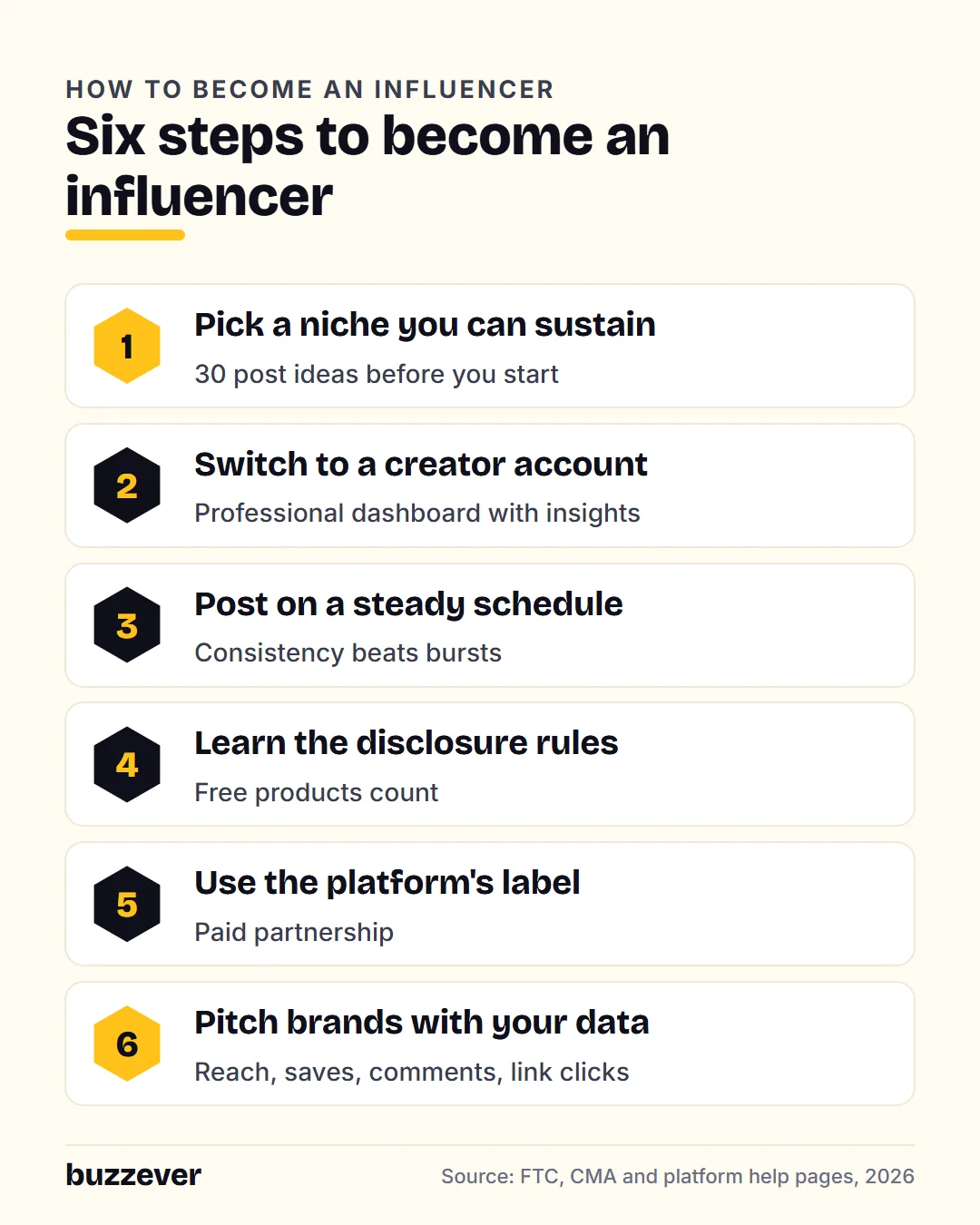
Below are six steps in the order we'd take them. The rules come from the regulators' own pages, the US Federal Trade Commission and the UK's Competition and Markets Authority, and the tools come from Instagram, TikTok and YouTube help pages, all checked in October 2026. You won't find income promises here. Nobody can honestly make them.
What an influencer actually is
An influencer is someone whose recommendations people act on. That's it. A big follower count without trust is just a number.
So the goal isn't fame. It's being the account people check before they decide something.
Step 1: Pick a niche you can sustain
Choose a subject you know well and won't get bored of, because you'll be making posts about it on tired days and busy days, for months, before you see much growth from it. Skincare for sensitive skin. Budget travel from one city. Home workouts with no equipment. Narrow is good, because it tells a new visitor exactly why they should follow.
A simple test: write down 30 post ideas before you start. If you run dry at twelve, the niche is too thin, or it isn't really yours.
Write a bio that says who you help and what they'll get. The free Instagram bio generator gives you drafts to edit.
Step 2: Switch to a creator account
On Instagram, a personal account can be changed to a business or creator account. Instagram says creator accounts are best for public figures, content producers, artists and influencers. In the app, go to your profile, open the menu, then under For professionals tap Account type and tools and choose Switch to professional account. Pick a category, then Creator.
You get a professional dashboard with insights and a view of which monetization tools you're eligible for. One warning: if your account is private, switching makes it public, and any pending follow requests are accepted.
On YouTube, think about a Brand Account from the start if anyone might help you manage the channel later. TikTok has its own business tools too, but the disclosure setting covered in step 5 works for creators either way.
Step 3: Post on a steady schedule
Consistency beats bursts. Pick a rhythm you can keep in a busy week, not your best week, and stick to it for three months before judging anything.
Use the insights from step 2 to see when your followers are actually online. The best time to post tool is a useful starting point until you have your own data.
Reply to comments. Ask questions in captions and stories. In our view, an audience that talks back is worth more than a silent one twice the size.
Step 4: Learn the disclosure rules
This is the step that separates a creator from a liability. Both regulators below say the same core thing: if a brand gave you something, your audience must be told, clearly, at the start.
The FTC's Disclosures 101 for Social Media Influencers says to disclose any financial, employment, personal or family relationship with a brand. Free or discounted products count. So do perks. You disclose even if you think your review is unbiased, and you can't talk about your experience with a product you haven't tried.
In the UK, the CMA's guidance for content creators, last updated in September 2025, says all commercial content must be clearly identifiable as an ad, no matter how many followers you have. Tagging a brand isn't enough. Neither is a discount code or an affiliate link on its own. The ASA also publishes an influencer guide written with the CMA.
| Question | US: FTC | UK: CMA |
|---|---|---|
| Do free products count? | Yes, anything of value | Yes, gifts and discounts too |
| Words that work | Ad, advertisement, sponsored, #ad | Ad, advert, advertising, advertisement |
| Words that don't | sp, spon, collab | #gifted, #spon, #sponsored, #collab, "thank you" |
| Where it goes | With the post itself, hard to miss, not only in a bio | Upfront, before people scroll or open the bio |
| Videos and live | Say it in the video; repeat it during a live | Clear as soon as people see the content |
Notice the difference: the FTC accepts "sponsored", the CMA calls it unclear. Put Ad at the start and you're covered by both.
Other countries have their own regulators and rules, so check yours. And the FTC adds that US law applies if it's reasonably foreseeable your post will affect US consumers, wherever you live. None of this is legal advice.
Step 5: Use the platform's label
Each big app has a built-in disclosure tool. Use it, and still say it in your own words.
- Instagram: its branded content policies require the paid partnership label to tag the brand. It works in Feed, Stories, Reels, Live, broadcast channels and videos, in the mobile app only. The brand approves your first request; until then the label shows without their name.
- TikTok: when a post promotes a brand, product or service, TikTok says you must turn on the commercial content disclosure. While posting, open Content disclosure and ads, switch on Disclose commercial content, then choose Your brand or Branded content. Branded content shows a Paid partnership label. TikTok says the setting doesn't change how it recommends your post, but undisclosed commercial content may not be eligible for the For You feed.
- YouTube: in the upload details, under Paid Promotion, select that the video includes branded content. YouTube then adds a disclosure label at the start of the video, and reminds creators they're still responsible for the law.
Why both? The FTC says don't assume that a platform's tool is good enough. The CMA says add #Ad upfront if the tool doesn't make it clear the post is an ad.
Step 6: Pitch brands with your data
When you approach a brand, lead with what your audience does, not how big it is. Reach, saves, comments, link clicks. Work out your engagement rate with the free engagement rate calculator and share screenshots straight from your insights.
Only pitch products you'd genuinely use. Then, when the deal happens, everything in steps 4 and 5 applies.
Read next: How to get verified on Instagram: both routes explained, How much does TikTok pay? What TikTok's Creator Rewards Program really pays on and How to start a YouTube channel: a 6-step setup.
Build trust first
Pick the niche, set up the account, show up on schedule and label every deal. The audience you build that way is the one brands want. More guides for creators are on Buzzever's Instagram page.
Questions readers ask
How many followers do you need to be an influencer?
There's no official number. What matters to brands is an engaged audience in one niche. And the UK disclosure guidance applies no matter how many followers you have, so the rules start with your first free product.
Do I have to disclose free products?
Yes. The FTC says to disclose if you got anything of value to mention a product, and the CMA treats gifts and discounts as something that needs a label.
Is #sponsored enough?
The FTC lists "sponsored" as clear. The CMA lists #sponsored among unclear terms. Using "Ad" at the start of the post works under both.
Is the paid partnership label enough on its own?
Not necessarily. The FTC says not to assume a platform's tool is good enough, and the CMA says to add #Ad if the tool doesn't clearly show the post is an ad. Use the label and say it yourself.
Do these rules apply outside the US and UK?
Every country sets its own rules. The FTC says US law applies if your post is likely to affect US consumers, even from abroad. YouTube's help page also names regulators in France, Germany and Korea. Check the regulator where you and your audience live.